
How matching works
How we match lost and found reports
For anyone who wants to know what happens after they report. No black box: here is what we compare.
On a phone
Live screens from the product, captured on a phone with demonstration data.
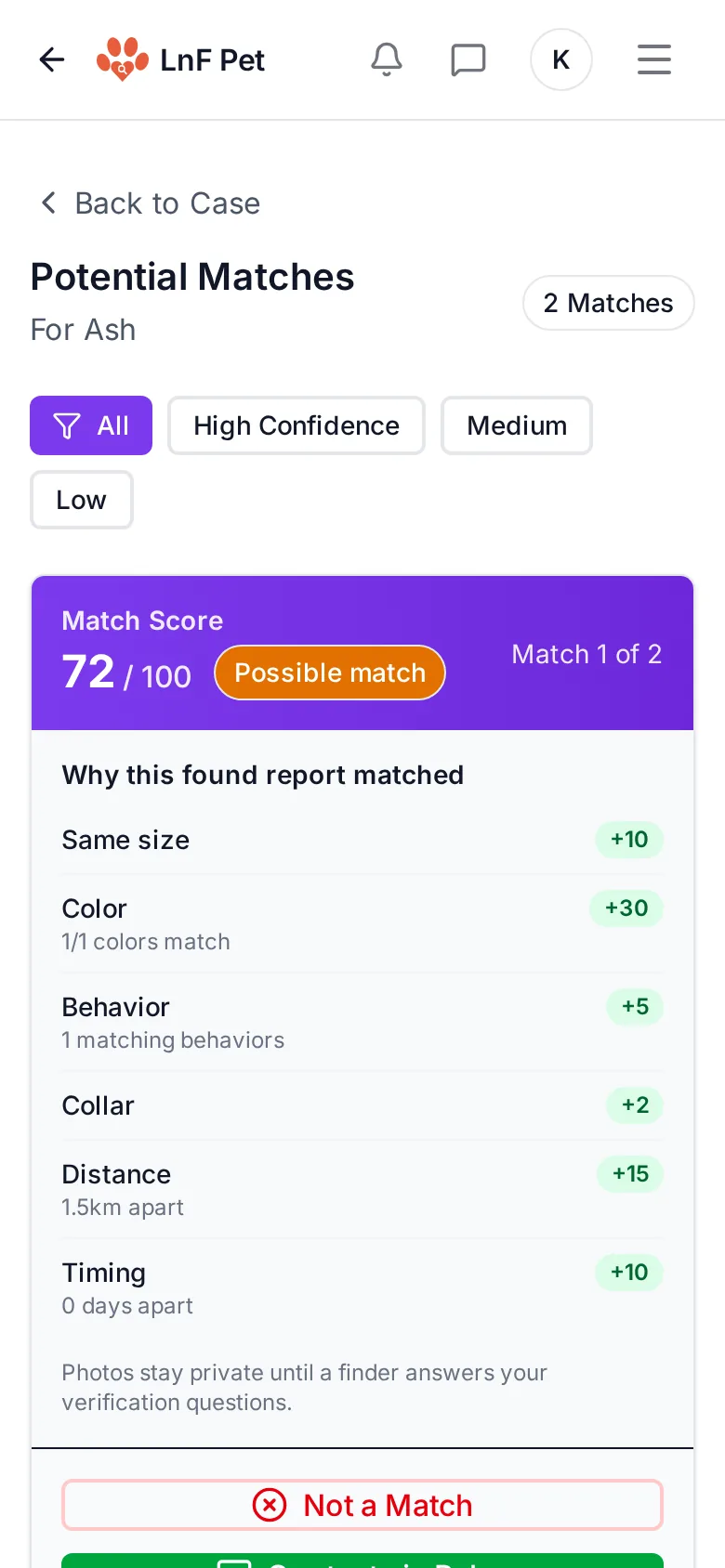
Descriptions, not photos
Every report captures the things that identify an animal without a photo: species, size, colour, breed, where and when. Our matcher scores each lost report against each found report and sighting on those descriptors. Because no photo is needed, people report sightings even when they are not sure.
Recovery guidance from LABRIE™
LABRIE™, the Lost Animal Behavioral Recovery Intelligence Engine developed by urSynergy Inc., guides recovery. Rather than relying on generative AI to guess where a lost animal might be, it combines established animal behaviour research with species and breed knowledge, location, time, environmental conditions and verified sightings. Every recommendation is meant to be transparent and explainable.
Every recovery helps the next family
Anonymized recovery outcomes are recorded and used to check how well past recommendations did. Using them to improve future recommendations is planned.
Questions
Is the matching done by AI?
No. Matching is a points system that compares descriptors such as species, size, colour, breed, place and time. Recovery guidance is grounded in published animal behaviour research, not generative AI.
Do I need a photo for a match?
No. Matching works on descriptions, which is why we don’t put photos on posters.